
The correct oil-fired steam boiler capacity should be selected from your factory’s maximum simultaneous steam demand, not simply from factory size or daily production. If your equipment requires a maximum combined steam flow of approximately 3,500 kg/h, for example, a 4 t/h boiler may be a more practical starting point than a 3 t/h boiler.
Using Dabonn Boiler’s current preliminary budget benchmark of approximately USD 14,000 per 1 t/h, a 4 t/h boiler would have a reference equipment budget of approximately USD 56,000.
Choosing the wrong capacity creates two expensive problems: a boiler that is too small can restrict production, while a significantly oversized boiler can increase initial investment and contribute to inefficient operation.
Why Is Boiler Capacity Selection So Important?
Correct boiler capacity directly affects whether your factory can maintain the steam supply required by production.
A common purchasing mistake is choosing capacity according to another factory.
For example:
“Our competitor uses a 6 ton boiler, so we also need a 6 ton boiler.”
That conclusion may be wrong.
Even factories producing similar products can have different steam requirements because of:
- Production line quantity
- Equipment size
- Batch cycle
- Simultaneous operation
- Steam pressure
- Operating hours
- Condensate recovery
- Future production expansion
Boiler sizing should therefore start from steam-consuming equipment, not from the name of the industry.
What Does 1 t/h Boiler Capacity Actually Mean?
A 1 t/h steam boiler is rated to generate approximately 1,000 kg of steam per hour under its specified operating conditions.
Therefore:
| Boiler Capacity | Rated Steam Output |
|---|---|
| 1 t/h | 1,000 kg/h |
| 2 t/h | 2,000 kg/h |
| 4 t/h | 4,000 kg/h |
| 6 t/h | 6,000 kg/h |
| 8 t/h | 8,000 kg/h |
| 10 t/h | 10,000 kg/h |
This simple conversion is important because industrial equipment specifications often state steam consumption in kg/h, while boiler manufacturers usually discuss capacity in t/h.
How Do You Calculate the Required Boiler Capacity?
Add the steam consumption of all equipment that can operate simultaneously, then evaluate peak demand and an appropriate engineering margin.
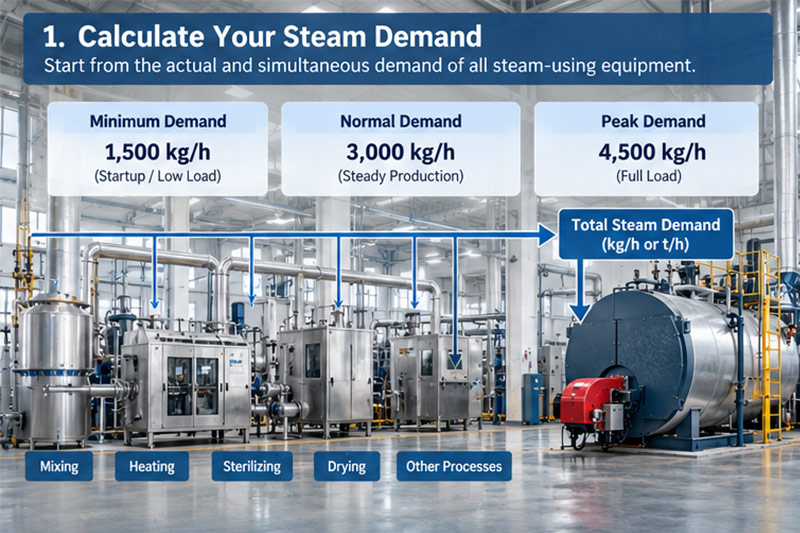
A simplified calculation is:
Required Steam Demand = Steam Demand of Equipment A + B + C + …
Consider a factory with four steam-consuming processes:
| Equipment | Steam Demand |
|---|---|
| Process A | 800 kg/h |
| Process B | 1,000 kg/h |
| Process C | 900 kg/h |
| Process D | 500 kg/h |
| Total | 3,200 kg/h |
If all four processes can operate simultaneously, the calculated demand is:
3,200 kg/h = 3.2 t/h
A 3 t/h boiler would be below this calculated simultaneous demand.
A 4 t/h boiler could therefore be evaluated as a more practical starting point, subject to pressure, process pattern, peak demand and engineering review.
Should You Simply Add 20% to the Required Capacity?
No. A fixed 20% oversizing rule should not automatically be applied to every industrial boiler project.
This is an important point that is often overlooked.
Engineering margin depends on the actual process.
A factory with stable continuous demand is different from a plant where several machines create short steam peaks.
Instead of automatically multiplying every calculation by 1.2, evaluate:
- Normal steam demand
- Maximum simultaneous demand
- Short-duration peak demand
- Startup demand
- Production expansion
- Boiler operating range
This produces a more defensible capacity decision.
How Much Does Each Boiler Capacity Cost?
Using the Dabonn Boiler preliminary benchmark, every 1 t/h of rated capacity represents approximately USD 14,000 of initial equipment budget.
| Capacity | Steam Output | Reference Price |
|---|---|---|
| 1 t/h | 1,000 kg/h | USD 14,000 |
| 2 t/h | 2,000 kg/h | USD 28,000 |
| 3 t/h | 3,000 kg/h | USD 42,000 |
| 4 t/h | 4,000 kg/h | USD 56,000 |
| 5 t/h | 5,000 kg/h | USD 70,000 |
| 6 t/h | 6,000 kg/h | USD 84,000 |
| 8 t/h | 8,000 kg/h | USD 112,000 |
| 10 t/h | 10,000 kg/h | USD 140,000 |
This demonstrates why capacity calculation matters financially.
If a factory actually requires 4 t/h but purchases a 6 t/h boiler without a process reason, the reference equipment budget difference is approximately:
USD 84,000 − USD 56,000 = USD 28,000
Oversizing is therefore not automatically “safer.”
Is a Larger Boiler Always Better?
No. A larger boiler is only better when the additional capacity serves a real operating or future production requirement.
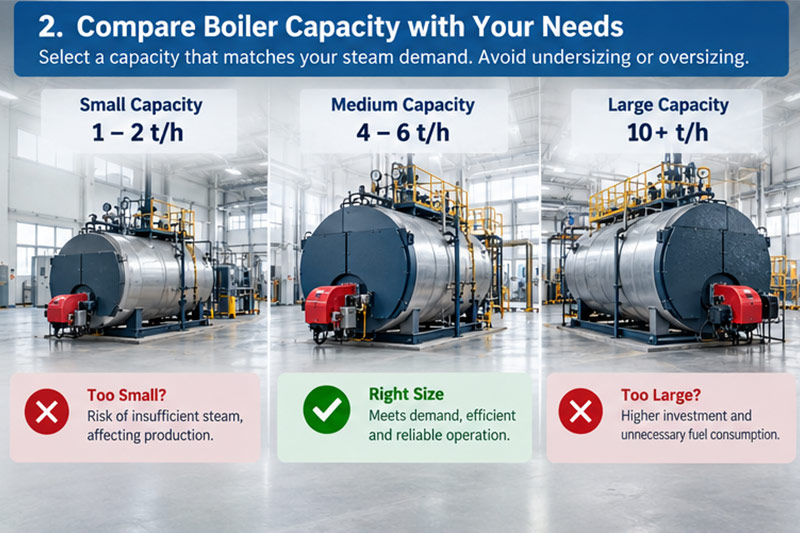
Purchasing a much larger boiler “just in case” can mean:
- Higher initial investment
- Larger installation space
- Larger auxiliary equipment
- Different fuel-system requirements
- More complex operation at low demand
At the same time, selecting a boiler with no capacity margin can create another problem: production may experience steam pressure instability when several processes operate simultaneously.
The objective is not to buy the largest boiler your budget allows.
The objective is to match boiler capacity to the factory’s real steam-load profile.
Should You Choose One Large Boiler or Two Smaller Boilers?
Multiple boilers can be a practical solution when a factory has large variations in steam demand or requires operational flexibility.
Consider a plant with peak demand near 8 t/h but significantly lower demand during some production periods.
Possible configurations could include:
- 1 × 8 t/h
- 2 × 4 t/h
Both provide 8 t/h of rated total capacity, but they behave differently operationally.
With two boilers, the factory may operate one unit during lower-load periods and bring the second unit online when steam demand increases.
Multiple boilers may also provide greater maintenance flexibility.
However, they can require additional piping, controls, valves, installation space and system integration.
The correct arrangement therefore depends on the plant’s load profile rather than capacity alone.
How Does Steam Pressure Affect Boiler Selection?
Required steam pressure must be determined together with capacity because a boiler must deliver both the required steam flow and the required pressure.
Knowing only that a factory needs “4 tons of steam” is incomplete.
A proper inquiry should state something like:
4 t/h steam capacity at the required operating pressure.
Pressure requirements depend on the process and equipment.
Do not simply specify a higher pressure because it appears more powerful. The boiler and steam system should be designed around the actual process requirement.
How Does Future Factory Expansion Affect Capacity Selection?
Planned production expansion should be considered before finalizing boiler capacity.
Suppose a factory currently consumes:
3,200 kg/h
but plans to add equipment requiring another:
1,500 kg/h
The future demand could reach:
4,700 kg/h
In this situation, buying only for today’s load could lead to another boiler investment after expansion.
But future capacity should be based on a real expansion plan, not an undefined possibility.
Ask:
- Is the new production line approved?
- When will it start?
- What is its estimated steam demand?
- Will it operate simultaneously with existing lines?
These answers make capacity planning much more reliable.
What Information Does Dabonn Boiler Need to Calculate Capacity?
A list of your steam-consuming equipment and operating conditions is usually the best starting point.
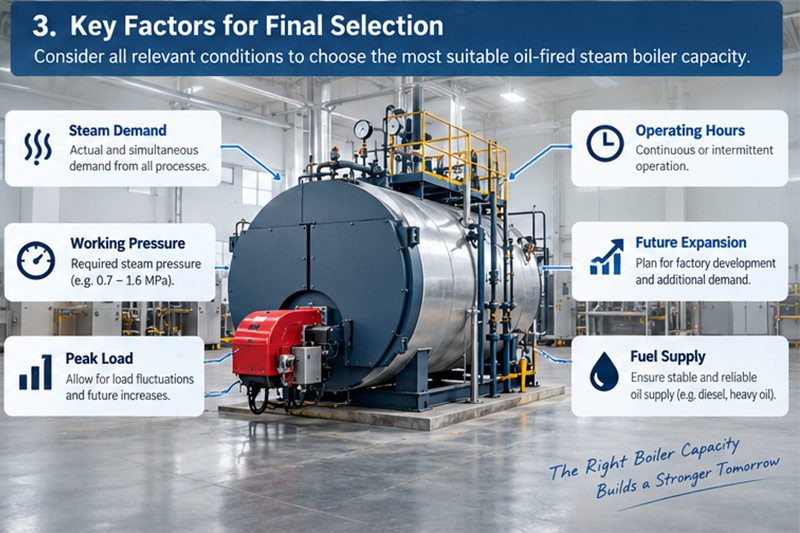
Provide:
- Equipment name
- Steam consumption in kg/h
- Number of units
- Whether units operate simultaneously
- Required steam pressure
- Daily operating hours
- Current and future production requirements
If exact steam consumption is unavailable, production data and process information can also be used for preliminary engineering discussion.
What Is Dabonn Boiler’s Practical Capacity-Selection Principle?
We recommend calculating the process first and selecting the boiler second.
Our practical sequence is:
Process equipment → simultaneous steam demand → peak demand → operating pattern → future demand → boiler capacity
This is more useful than starting with:
“I want a 6 ton boiler.”
The difference is important.
The first approach identifies what the factory needs.
The second assumes the answer before the steam demand has been calculated.
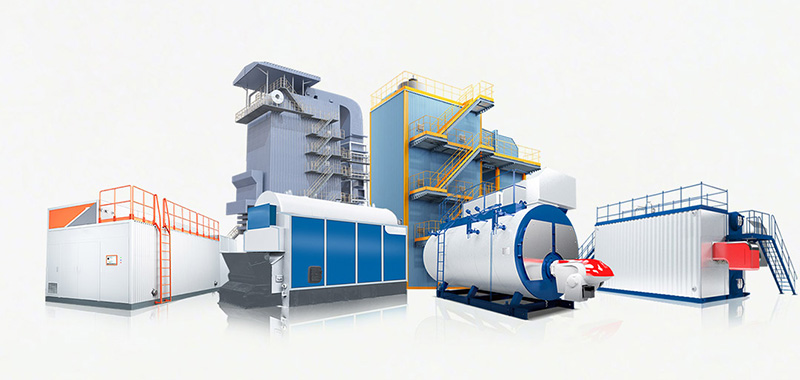
About Dabonn Boiler
Dabonn Boiler manufactures industrial steam boilers and hot water boilers for oil, gas, biomass, coal, electric and customized thermal applications.
With more than 30 years of manufacturing experience, our industrial boiler solutions have been supplied to customers in more than 130 countries and regions, serving more than 10,000 industrial customers.
For capacity selection, our engineering discussions focus on actual process requirements rather than simply recommending a larger boiler.
Frequently Asked Questions
What size boiler do I need for 2,000 kg/h of steam?
A 2 t/h boiler corresponds to approximately 2,000 kg/h of rated steam output, but peak demand and operating margin should be reviewed before final selection.
What size boiler do I need for 3,500 kg/h?
A 4 t/h boiler is a practical capacity to evaluate for a calculated 3,500 kg/h demand because a 3 t/h boiler would be below that steam requirement.
How much does a 4 t/h oil-fired steam boiler cost?
A 4 t/h oil-fired steam boiler can be budgeted at approximately USD 56,000 using the Dabonn Boiler preliminary reference benchmark.
How much does a 6 t/h oil-fired boiler cost?
A 6 t/h oil-fired steam boiler has a preliminary reference price of approximately USD 84,000 before project-specific adjustments.
Is an oversized boiler safer?
No. Significant oversizing does not automatically make a boiler project better. Capacity should be matched to actual and planned steam demand.
Can I use two smaller boilers instead of one large boiler?
Yes. Multiple boilers can provide load flexibility and maintenance advantages, but installation cost, controls, piping and operating requirements must also be considered.
Should future expansion be included when selecting capacity?
Yes. Confirmed or realistically planned production expansion should be included in the steam-demand calculation.
What information is needed to calculate industrial boiler capacity?
Provide the steam consumption, operating schedule and pressure requirements of your production equipment. If these figures are unavailable, provide production and process information for preliminary analysis.
Conclusion
The correct oil-fired steam boiler capacity is determined by maximum simultaneous steam demand, peak load, operating pattern and realistic future expansion.
Start by converting your equipment demand into kg/h. Remember:
1 t/h = approximately 1,000 kg/h of rated steam output.
Then compare the calculated requirement with available boiler capacities.
Capacity selection also has a direct effect on investment. Using our preliminary budgeting benchmark, 2 t/h is approximately USD 28,000, 4 t/h approximately USD 56,000, 6 t/h approximately USD 84,000 and 10 t/h approximately USD 140,000.
Calculate the steam demand first. Then choose the boiler.
That simple order can prevent both insufficient steam supply and unnecessary capital expenditure.