
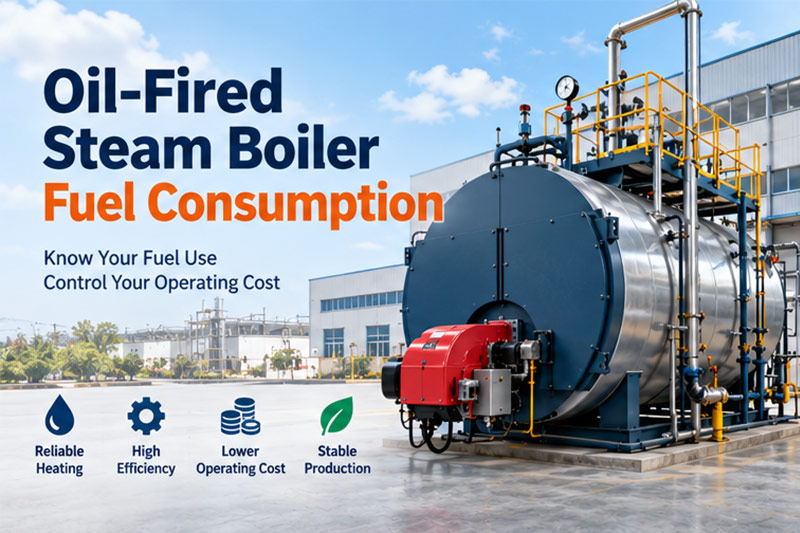
An industrial oil-fired steam boiler typically requires roughly 60–70 kg of oil per hour for each 1 t/h of steam capacity under common operating assumptions, but actual fuel consumption must be calculated from steam conditions, feedwater temperature, fuel calorific value, boiler efficiency and operating load.
For preliminary budgeting, this means a 2 t/h boiler may consume roughly 120–140 kg/h, while a 10 t/h boiler may consume roughly 600–700 kg/h.
These figures are reference estimates rather than guaranteed consumption values.
This distinction matters because the purchase price of a boiler is paid once, while fuel is purchased every day the boiler operates. Over the life of an industrial steam system, even a small difference in hourly fuel consumption can become a significant operating cost.
Why Is Oil Consumption Important Before Buying a Boiler?
Fuel consumption is one of the most important figures for estimating the long-term operating cost of an oil-fired boiler.
A factory may focus first on the purchase price.
For example, using Dabonn Boiler’s preliminary equipment-price benchmark:
- 1 t/h: approximately USD 14,000
- 2 t/h: approximately USD 28,000
- 6 t/h: approximately USD 84,000
- 10 t/h: approximately USD 140,000
But after installation, the boiler may operate 8, 12 or even 24 hours per day.
Fuel cost therefore repeats every operating hour.
A buyer who compares only boiler purchase prices may overlook the larger financial question:
How much will this boiler cost to operate every year?
How Do You Calculate Oil Consumption for a Steam Boiler?
Oil consumption can be estimated from the energy required to produce steam, divided by the usable energy supplied by the fuel.
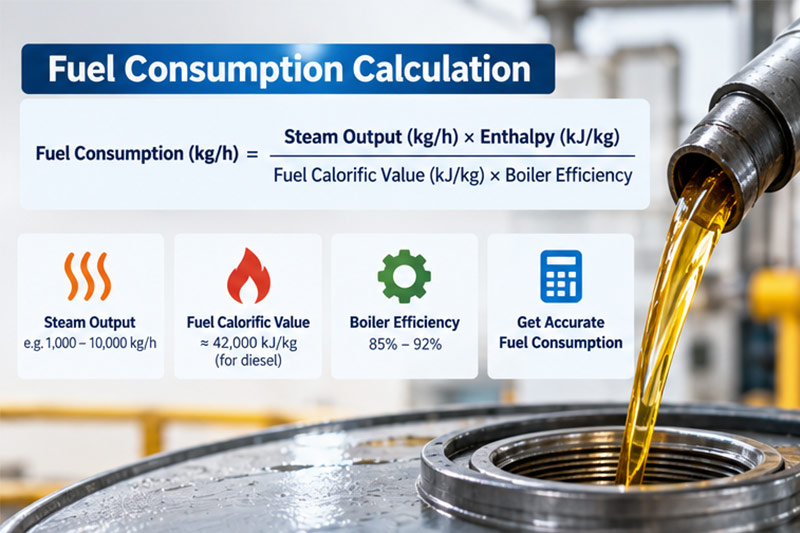
A simplified engineering relationship is:
Fuel Consumption = Steam Output × Required Heat per kg of Steam ÷ (Fuel Calorific Value × Boiler Efficiency)
The exact calculation depends on several variables:
- Steam pressure
- Steam condition
- Feedwater temperature
- Fuel calorific value
- Boiler efficiency
- Actual operating load
This is why a universal statement such as “a 1 ton boiler always consumes exactly 65 kg/h” is not technically reliable.
For early project budgeting, however, a practical range can still be useful.
What Is the Approximate Fuel Consumption of a 1–10 t/h Oil-Fired Boiler?
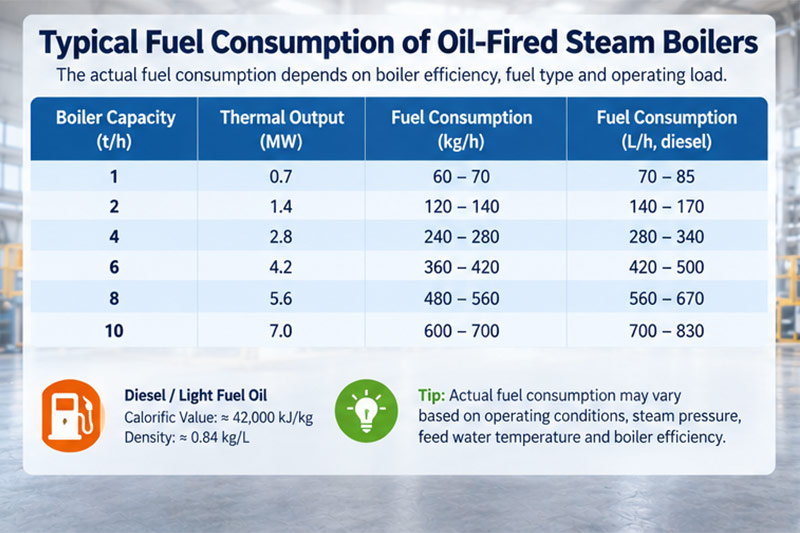
A practical preliminary range is approximately 60–70 kg/h of oil per 1 t/h of steam capacity under common assumptions.
| Boiler Capacity | Steam Output | Reference Oil Consumption |
|---|---|---|
| 1 t/h | 1,000 kg/h | 60–70 kg/h |
| 2 t/h | 2,000 kg/h | 120–140 kg/h |
| 3 t/h | 3,000 kg/h | 180–210 kg/h |
| 4 t/h | 4,000 kg/h | 240–280 kg/h |
| 5 t/h | 5,000 kg/h | 300–350 kg/h |
| 6 t/h | 6,000 kg/h | 360–420 kg/h |
| 8 t/h | 8,000 kg/h | 480–560 kg/h |
| 10 t/h | 10,000 kg/h | 600–700 kg/h |
These numbers should be used for preliminary estimation only.
A project-specific calculation should use the actual fuel specification and operating conditions.
How Much Oil Does a 2 t/h Steam Boiler Consume?
A 2 t/h oil-fired steam boiler can be preliminarily estimated at approximately 120–140 kg of oil per hour under common operating assumptions.
At rated capacity, the boiler produces approximately:
2,000 kg of steam per hour.
If the boiler consumes 130 kg/h as a working example and operates for 10 hours:
130 × 10 = 1,300 kg of oil per day
If it operates for 300 days:
1,300 × 300 = 390,000 kg of oil per year
This example demonstrates why hourly fuel consumption deserves attention during procurement.
The actual annual consumption may be very different because industrial boilers do not necessarily operate continuously at rated load.
How Much Oil Does a 6 t/h Steam Boiler Consume?
A 6 t/h oil-fired steam boiler can be preliminarily estimated at approximately 360–420 kg/h of oil.
Using 390 kg/h as a calculation example:
If the boiler operates:
12 hours/day × 300 days/year = 3,600 hours/year
then theoretical annual fuel consumption at that assumed load would be:
390 kg/h × 3,600 h = 1,404,000 kg/year
This is a calculation example, not a guaranteed consumption figure.
Actual consumption depends strongly on load.
If the boiler operates at reduced output for much of the day, actual annual fuel use should be calculated from the real load profile rather than rated capacity.
How Much Oil Does a 10 t/h Steam Boiler Consume?
A 10 t/h oil-fired steam boiler can be preliminarily estimated at approximately 600–700 kg/h under common assumptions.
The boiler produces approximately:
10,000 kg/h of steam at rated capacity.
Using 650 kg/h as an example:
650 kg/h × 10 hours = 6,500 kg/day
At 300 operating days:
6,500 × 300 = 1,950,000 kg/year
Again, this is an illustrative calculation based on assumed operation.
For an actual 10 t/h project, Dabonn Boiler would calculate fuel requirements from the selected fuel, steam pressure, feedwater conditions, efficiency assumptions and expected operating load.
How Do You Calculate the Hourly Fuel Cost?
Hourly fuel cost is calculated by multiplying hourly fuel consumption by the local fuel price.
The formula is:
Hourly Fuel Cost = Fuel Consumption × Fuel Price per kg
For example, assume:
- Fuel consumption: 390 kg/h
- Example oil price: USD 0.80/kg
Then:
390 × 0.80 = USD 312/hour
If the factory operates the boiler for 12 hours:
USD 312 × 12 = USD 3,744/day
The USD 0.80/kg figure is only an example. Buyers should replace it with their actual local fuel purchase price.
This calculation is particularly useful when comparing different boiler configurations or fuel options.
Does Boiler Efficiency Affect Fuel Consumption?
Yes. Higher usable boiler efficiency reduces the amount of fuel required to produce the same useful steam output when the other operating conditions remain comparable.
The reason can be seen directly from the simplified formula:
Fuel Consumption ∝ 1 ÷ Efficiency
If less of the fuel’s energy is converted into useful steam generation, more fuel must be supplied to achieve the same output.
However, buyers should compare efficiency claims carefully.
Ask whether the stated value refers to:
- Rated conditions
- Particular fuel
- Particular load
- Specific test method
- Higher or lower heating value basis
A single efficiency percentage without operating conditions does not tell the whole story.
Does Feedwater Temperature Affect Oil Consumption?
Yes. Higher feedwater temperature generally reduces the additional energy required to convert water into steam.
This is one reason condensate recovery can be important in industrial steam systems.
Hot condensate returned from production still contains useful thermal energy.
If this energy is recovered rather than discharged, the boiler needs less additional heat to bring the returning water back to steam-generating conditions.
The actual savings depend on:
- Condensate return percentage
- Condensate temperature
- Makeup water temperature
- Steam pressure
- Boiler efficiency
- System losses
Therefore, fuel consumption should be evaluated as part of the complete steam system, not only the burner.
Does an Economizer Reduce Fuel Consumption?
Yes. An appropriately designed economizer can recover part of the heat from boiler flue gas and use it to preheat boiler feedwater or another suitable medium.
This reduces the amount of additional fuel energy required inside the boiler.
However, the actual benefit depends on the boiler design, exhaust temperature, feedwater conditions, fuel characteristics and operating load.
For oil-fired systems, fuel properties and low-temperature corrosion considerations should also be evaluated when determining the appropriate exhaust heat-recovery arrangement.
Is the Cheapest Oil-Fired Boiler the Cheapest to Operate?
No. The lowest purchase price does not automatically mean the lowest lifetime operating cost.
Consider a 10 t/h boiler.
Our preliminary equipment budget reference is approximately:
USD 140,000
But the boiler may consume hundreds of kilograms of fuel every operating hour.
Even a relatively small percentage difference in actual fuel use, multiplied by thousands of operating hours, can become financially significant.
Industrial buyers should therefore compare:
Purchase Cost + Fuel Cost + Water Treatment + Electricity + Maintenance + Expected Service Life
rather than boiler price alone.
How Can a Factory Reduce Oil-Fired Boiler Fuel Consumption?
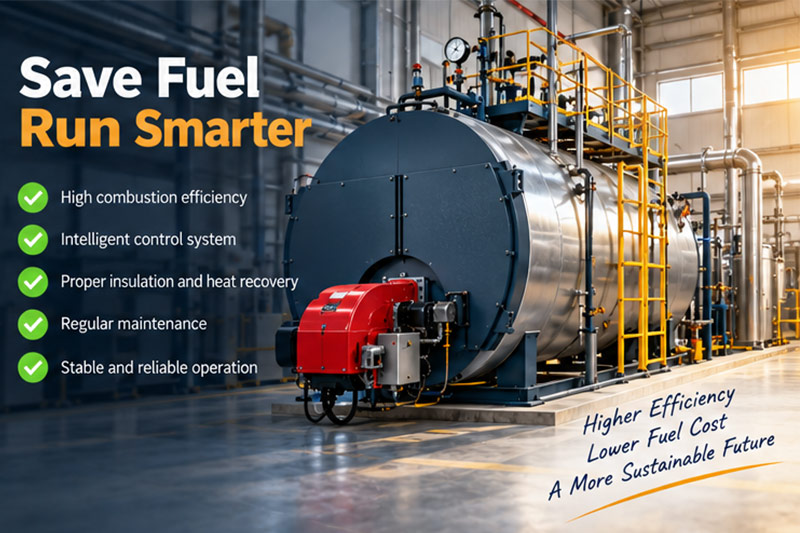
Factories can reduce avoidable fuel consumption by matching boiler output to actual demand and reducing energy losses throughout the steam system.
Important areas to investigate include:
- Correct boiler sizing
- Combustion adjustment
- Burner maintenance
- Feedwater temperature
- Condensate recovery
- Flue-gas heat recovery
- Steam-pipe insulation
- Steam leakage
- Blowdown management
- Operating load
For example, improving the boiler itself while ignoring leaking steam lines can waste part of the expected energy saving.
The entire steam system should be considered.
What Is Dabonn Boiler’s Approach to Fuel-Consumption Estimates?
Dabonn Boiler separates preliminary budgeting figures from project-specific engineering calculations.
For early discussions, approximately 60–70 kg/h of oil per 1 t/h of steam capacity can be used as a practical reference range.
For a formal project, however, fuel consumption should be calculated using actual project data.
We consider factors such as:
- Required steam output
- Steam pressure
- Feedwater temperature
- Fuel specification
- Fuel calorific value
- Expected boiler efficiency
- Operating load
This produces a more meaningful estimate than using one fixed fuel-consumption number for every project.
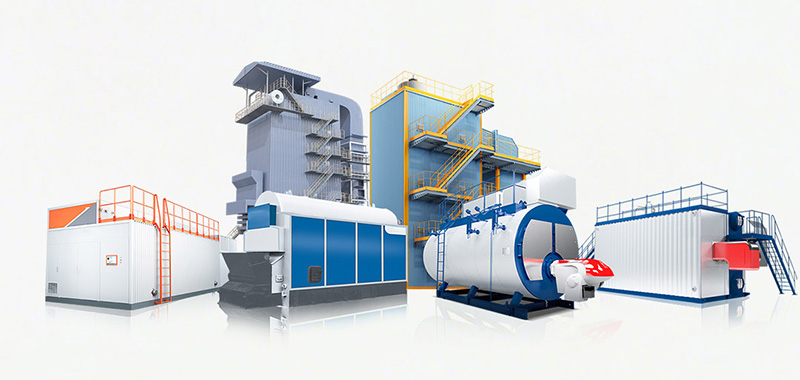
About Dabonn Boiler
Dabonn Boiler supplies oil-fired steam boilers and other industrial thermal systems for factories and industrial projects worldwide.
With more than 30 years of boiler manufacturing experience, Dabonn Boiler has served customers in more than 130 countries and regions and more than 10,000 industrial customers.
Our industrial boiler solutions include oil, gas, biomass, coal, electric and customized heating systems.
Frequently Asked Questions
How much oil does a 1 t/h steam boiler consume?
A 1 t/h oil-fired steam boiler can be preliminarily estimated at approximately 60–70 kg/h of oil under common operating assumptions.
How much oil does a 2 t/h steam boiler consume?
A 2 t/h oil-fired steam boiler can be preliminarily estimated at approximately 120–140 kg/h.
How much oil does a 6 t/h steam boiler consume?
A 6 t/h oil-fired steam boiler can be preliminarily estimated at approximately 360–420 kg/h.
How much oil does a 10 t/h steam boiler consume?
A 10 t/h oil-fired steam boiler can be preliminarily estimated at approximately 600–700 kg/h under common operating assumptions.
Is boiler fuel consumption fixed?
No. Actual consumption changes with steam pressure, feedwater temperature, fuel calorific value, boiler efficiency and operating load.
Does condensate recovery reduce fuel consumption?
Yes. Returning hot condensate can reduce the energy required to heat boiler feedwater again, although actual savings depend on the system.
How do I calculate the hourly operating cost of an oil boiler?
Multiply actual hourly fuel consumption by the local fuel price. For example, 390 kg/h × USD 0.80/kg equals approximately USD 312 per hour.
Should I compare boiler price or fuel consumption first?
Both should be evaluated. Purchase price determines initial investment, while fuel consumption can dominate operating expenditure over many years of boiler use.
Conclusion
A useful preliminary estimate for an oil-fired steam boiler is approximately 60–70 kg of oil per hour for every 1 t/h of steam capacity under common assumptions.
That gives approximately:
2 t/h: 120–140 kg/h
6 t/h: 360–420 kg/h
10 t/h: 600–700 kg/h
These values are budgeting references, not guaranteed consumption figures.
For an actual project, calculate fuel consumption from the required steam conditions, feedwater temperature, fuel calorific value, boiler efficiency and real operating load.
The boiler purchase price matters—but for a boiler operating thousands of hours, fuel consumption can matter much more over the complete operating life of the equipment.